



The Complete Guide to Sustainable Landscaping in Sonoma County
Sonoma County is one of the most beautiful places to own property in California, and one of the most demanding when it comes to caring for the land around it. Long dry summers, periodic wildfire risk, tightening water regulations, and clay-heavy soils all shape what it means to have a landscape that genuinely thrives here.
For many property owners, that reality is pushing a shift away from thirsty, high-maintenance lawns toward something more intelligent: landscapes built to work with Sonoma County’s conditions rather than fight them. Partnering with a knowledgeable sustainable landscaping company in Sonoma is the clearest path to getting it right, from the first site walk through design, installation, and ongoing care.
This guide covers the full picture of what sustainable landscaping involves in our region, and where a topic deserves more detail, we’ve linked to a dedicated blog that goes further.
Key Takeaways
- Sustainable landscaping means designing for our specific climate (dry summers, wet winters, fire risk, and clay soils) not just selecting drought-tolerant species.
- Water management is often where a sustainable landscape succeeds or quietly falls short.
- Native plants, thoughtful hardscape, pollinator habitat, and year-round maintenance work best as a connected system.
- Several Sonoma County ordinances and rebate programs shape what’s required, knowing them upfront saves time and money.
- A certified design-build partner handles everything from permit paperwork to irrigation programming under one roof.
What “Sustainable Landscaping” Actually Means Here
The term gets used loosely, so it’s worth being specific about what it means in Sonoma County’s context.
A sustainable landscape here is designed to:
- Use water efficiently — matching plant needs to irrigation delivery, reducing runoff, and capturing water where possible
- Support the local ecosystem — native pollinators, birds, and soil biology that keep a landscape healthy from the ground up
- Reduce fire risk — through plant selection, spacing, and materials that contribute to defensible space
- Minimize ongoing inputs — fewer chemical treatments, less fertilizer, and lower maintenance demands over time
- Work with site conditions — sun exposure, soil type, slope, drainage, and microclimate
This is different from putting down gravel or swapping in a few succulents. Done well, it’s an artform backed by real horticultural science, and it’s the foundation of every project we take on at Inspired Landscapes.
Before You Design: Your Site Assessment Checklist
The most valuable thing a property owner can do before any design work begins is walk their property with clear eyes. A productive first conversation with a designer goes much faster when you’ve already noted the basics.
Inventory What’s There
- Existing plants and lawn areas — what’s thriving, what’s struggling, how much turf you’re currently watering
- Your irrigation system — controller location, valve layout, approximate age, and whether it runs spray or drip
- Hardscape and structures — patios, walkways, retaining walls, and their general condition
- Drainage patterns — where water pools after rain, and where it moves toward structures or neighboring property
- Shade and sun — how light shifts across the property at different times of day (photos help)
Clarify Your Priorities
“Sustainable” means different things to different owners. Before your first consultation, think through your primary motivation: is it lower water bills, fire resistance, less maintenance, pollinator habitat, or some combination? Consider how you actually use the space: entertaining, edible gardens, wildlife habitat, or simply something beautiful to look at. Budget and phasing matter too, whether you’re doing the whole property at once or rolling it out over multiple seasons.
Know the Regulatory Layer
Sonoma County has real rules that shape design, and they’re easier to navigate when you know about them early:
- MWELO (Model Water Efficient Landscape Ordinance) — applies to many larger or renovated projects, typically requiring hydrozone mapping and water-use calculations
- HOA guidelines — approved plant lists, fence heights, and hardscape restrictions vary by community
- Defensible space requirements — fire-hazard zones have zone-based rules for what can be planted near structures
- Permit requirements — retaining walls above certain heights and significant grading often require review
Pro Tip: You don’t need every answer before your first call. A good designer will work through these questions with you during the site visit, the checklist above just helps you make the most of that time.
Converting a Lawn to Sustainable Landscaping
California’s lawn-conversion moment is well underway, and in Sonoma County, real incentives are pushing property owners to move sooner rather than later.
AB 1572, California’s non-functional turf law, phases out potable-water irrigation of decorative turf, starting with public agencies in January 2027, commercial properties in 2028, and HOA common areas in 2029. Private residential lawns aren’t currently covered, but many estate, winery, and HOA-adjacent properties have a real compliance clock running. At the same time, active rebate programs through the Sonoma-Marin Saving Water Partnership are open to residential and commercial property owners in several cities, including Santa Rosa, Healdsburg, Rohnert Park, Cotati, and Sonoma.
The Four Steps That Make a Conversion Last
A lawn conversion that works is a sequence, and each step sets up the next:
- Site and lawn assessment — evaluating sun exposure, drainage, existing irrigation, slope, and how the space is actually used
- Soil preparation — most turf areas sit on compacted soil that won’t support drought-tolerant plants the way it supported grass; amendment and aeration are what make a plant genuinely drought-tolerant over time
- Designing the replacement landscape — selecting native and climate-adapted plants suited to your conditions, grouped by water need (hydrozoning) so nothing gets over- or under-watered
- Irrigation conversion — retrofitting or redesigning away from spray heads built for turf, typically to drip irrigation paired with a smart, weather-based controller
Native and Climate-Adapted Plants: Getting the Foundation Right
The plant palette is the heart of any sustainable landscape, and the distinction between native plants and simply drought-tolerant plants matters more than most people expect.
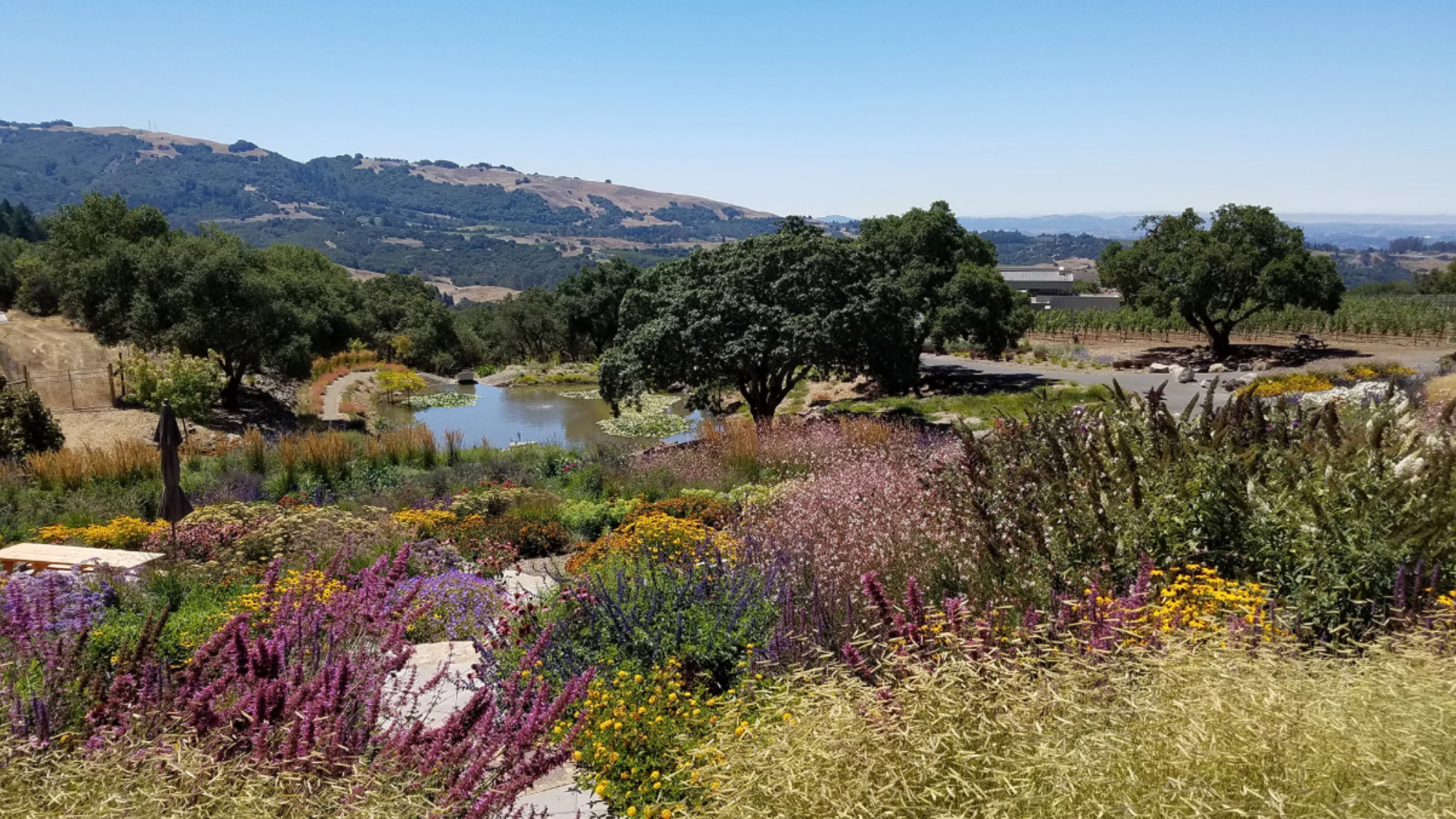
A native plant evolved in this specific region over thousands of years, alongside our soils, rainfall patterns, and dry summers. Coast live oak, manzanita, ceanothus, and California buckwheat are examples. Because they developed alongside local pollinators and soil biology, they support the broader ecosystem in ways imported species often can’t.
Drought-tolerant plants is a broader category that includes natives, but also plants from Mediterranean Europe, South Africa, Australia, and other dry-climate regions. We frequently blend both: natives provide the ecological backbone, and climate-adapted plants round out the palette with additional color, texture, and seasonal performance.
Practical Answers to Common Questions
Will a native landscape look wild or unkempt? Not with a thoughtful design. Structure — defined pathways, clean hardscape edges, and intentionally grouped plantings — is what separates a polished native garden from an overgrown one.
Do native plants need any water at all? Yes, especially during the first one to two growing seasons while roots establish. After that, most shift to occasional deep watering through the dry season. A customized irrigation plan matters far more than any generic watering rule.
Are native plants fire-safe? Yes, when chosen and maintained with fire safety in mind. Many California natives, paired with proper spacing and regular removal of dead material, support both a beautiful landscape and better fire resilience.
Building a Pollinator-Friendly Landscape
Pollinator habitat has become one of the most requested elements of sustainable design in Sonoma County, and for good reason. Vineyard expansion and traditional ornamental landscaping have steadily reduced what native bees, butterflies, and hummingbirds depend on. A well-designed pollinator garden gives something back to the ecosystem your property is already part of.
Five Best Practices
- Plant for bloom succession. Choose species that flower at different times of year, ceanothus and manzanita in late winter and early spring; salvia, California fuchsia, and yarrow in summer; aster, goldenrod, and California buckwheat in fall. Overlapping windows mean pollinators always have a food source.
- Provide shallow water. Bees and butterflies need shallow water to land safely. A basin with stones or marbles, a small recirculating fountain, or a shallow creek-bed feature in part shade all work well.
- Skip synthetic pesticides. Systemic insecticides are absorbed into plant tissue, including the nectar pollinators feed on. An organically based fertilization program protects plants without putting pollinators at risk.
- Build habitat zones, not just flower beds. Bare, undisturbed soil supports ground-nesting native bees. Host plants support butterfly reproduction. A brush or log pile provides overwinter shelter. Set aside at least one slightly wilder corner for these purposes.
- Time your pruning. Avoid heavy pruning of spent flower heads in fall and winter — hollow stems and seed heads shelter overwintering insects. Spring is the best window for major pruning in Sonoma County, after pollinators have moved on from dormant plants.
A Real-World Example: Petaluma Pollinator Garden
When a homeowner just blocks from downtown Petaluma came to us with an overgrown, underperforming backyard, we rebuilt it from the ground up, starting with depleted soil that needed mycorrhizal fungi, beneficial bacteria, and organic matter before planting could begin. Sweeping flagstone paths replaced rigid concrete, and a native palette including California buckwheat, California fuchsia, showy milkweed, and carmel creeper turned the space into a living ecological network supporting monarch butterflies, hummingbirds, and native bees year-round.
Water Management: Irrigation, Smart Controllers, and Rainwater
Landscapes account for roughly 9% of California’s total water use, making irrigation one of the most impactful decisions in any sustainable landscape design.
Smart Controllers vs. Basic Timers
A standard irrigation timer runs a fixed schedule until you manually change it. It has no awareness of rainfall, temperature, or evapotranspiration (ET), the rate at which water leaves soil and plants. Over- and under-watering are the predictable result.
A weather-based smart controller pulls local ET and weather data, automatically adjusting run times per zone without manual reprogramming. WaterSense-certified models are rated to reduce outdoor water use by at least 20% versus a standard timer. Add a flow sensor, and the system can flag leaks before they waste water undetected for weeks. Smart controllers also meet Sonoma County’s Water Efficient Landscape Ordinance requirement for new and qualifying renovated landscapes, a basic timer typically won’t.
Our team beta-tested some of the first Wi-Fi-enabled irrigation controllers and has spent years programming them for Sonoma County’s specific soil conditions and plant mixes. For multi-zone residential and estate properties, the upgrade typically pays for itself in water savings.
Rainwater Harvesting and Greywater
More Sonoma County property owners are looking beyond the tap, and the regulatory framework supports it.
Rain barrels (50 to 100 gallons) carry small beds through dry stretches between storms.
Cisterns scale the concept up to several thousand gallons for larger properties.
Laundry-to-landscape greywater systems reuse water from a clothes washer through a labeled three-way valve, and are typically permit-exempt under the California Plumbing Code when they meet specific guidelines, though local rules in Sonoma County can add notification or permitting requirements.
Capturing water is only half the equation. A well-designed irrigation system (with right-sized drip lines, proper hydrozoning, and a smart controller) is what turns stored water into water your plants can actually use.
Safety Note: Confirm current local requirements with Sonoma County before installing any rainwater or greywater system. Regulations vary by jurisdiction and may change.
Hardscape: Materials That Hold Up in Sonoma County
Sustainable landscaping isn’t only about plants and water. Patios, pathways, retaining walls, and outdoor living spaces play a significant role in how a landscape functions, and material choice matters more here than most people expect. We evaluate every hardscape option on four local factors: heat and drought tolerance, drainage performance, fire-area suitability, and realistic upkeep.
- Flagstone — holds color in full sun, non-combustible, can be set with permeable joints for better winter drainage; requires periodic joint maintenance
- Concrete and permeable pavers — flexible in style; permeable systems manage winter runoff and often support MWELO compliance; individual units can be replaced without redoing a full surface
- Poured and stamped concrete — budget-friendly for large areas like driveways and pool decks; non-combustible; proper base prep and drainage slope are critical to prevent cracking
- Decomposed granite and gravel — naturally permeable, fire-wise (doesn’t carry flame like bark mulch), accessible in cost, easy to repair
- Natural stone veneer — applied to retaining walls, fire pits, and seating walls; the finishing detail that often elevates a functional hardscape into a designed outdoor space
Pro Tip: How hardscape is installed (base preparation, drainage planning, and fire-code awareness) determines whether it holds up long-term. Local experience matters as much as material selection.
Year-Round Maintenance: Keeping It Healthy Every Season
A sustainable landscape doesn’t run itself, but with the right seasonal care, it comes close. Sonoma County’s Mediterranean climate gives us one of the most distinct seasonal rhythms in California, and matching your maintenance calendar to it makes a real difference.
Winter
Structural pruning of dormant shrubs, fruit trees, and ornamentals. Soil amendments while the ground is workable. Reducing plant density also lowers dry fuel load before fire season.
Spring
Irrigation system inspection and reprogramming before temperatures climb. Smart controller calibration. Preferred planting window for native and drought-tolerant species to establish roots before summer.
Summer
Monthly irrigation adjustments as heat peaks, June schedules don’t work by August. Fire safety vegetation management: removing dry and dead material near structures, keeping mulch back from wood.
Fall
Fresh mulch application (two to four inches, pulled back from crowns) retains moisture, suppresses weeds, and builds soil health. Cleanup of spent annuals and diseased vegetation. Final irrigation check before the rainy season.
Our maintenance team holds PLANET LIC Horticulture Technician, QWEL, CLCA Water Manager, and Bay Friendly Landscape Manager certifications. Every landscape we maintain receives monthly walkthroughs from a horticultural supervisor, seasonal pruning timed to its specific plant palette, ET-based irrigation adjustments, and organically based fertilization customized per site.
Why Work with a Sustainable Landscaping Company in Sonoma
A sustainable landscape is only as good as the expertise behind it. Sonoma County’s combination of climate, fire risk, water regulations, and site diversity means general landscaping experience doesn’t automatically translate to sustainable landscaping done well.
At Inspired Landscapes, we bring:
- Certifications: QWEL (Qualified Water Efficient Landscaper), CLCA Certified Water Manager, PLANET LIC Horticulture Technician, Bay Friendly Landscape Manager, CA Contractor License #1091187
- Design-build under one roof: site assessment, design, installation, irrigation, and maintenance handled by the same team, no handoffs between separate contractors
- Regulatory expertise: MWELO documentation, WUCOLS calculations, hydrozone maps, HOA coordination, and fire-rebuild permitting handled as part of the design process
- Firm, transparent pricing: every project element analyzed before estimating; bids don’t shift midway through a project
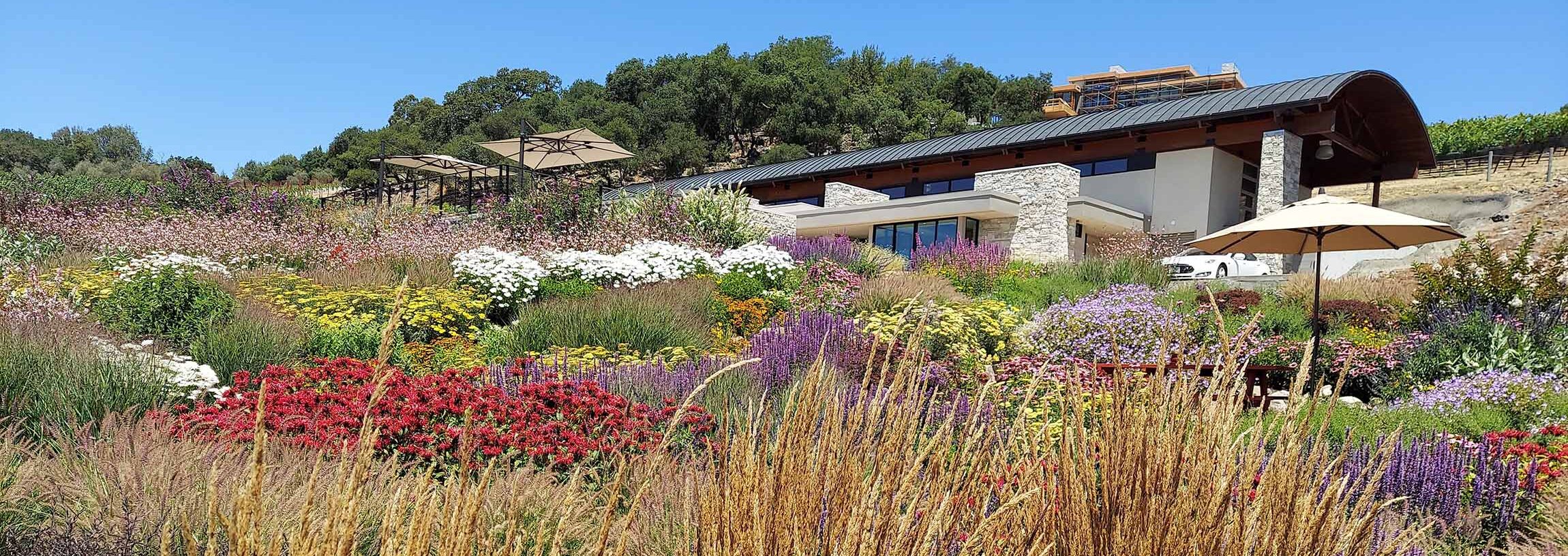
- 15+ years of local experience: across Sonoma and Napa County, from small bungalow patios to multi-acre estate and winery properties, including recognized work like our CLCA 2021 First Place Installation Sweepstakes win at Coursey Graves Winery
What to Do Next
- Walk your property. Use the inventory checklist in this guide to note what you have, what’s working, and what you’d like to change.
- Clarify your top priorities. Water savings, fire resistance, less maintenance, pollinator habitat, or some combination.
- Book a free consultation. We walk your site with you, talk through your goals, and give you an honest read on what the space can become, at no cost.
Ready to Build Something That Belongs Here?
Sustainable landscaping in Sonoma County is what we do, across residential, estate, and winery properties, from first-time sustainable landscapes to post-fire rebuilds. If you’re ready to have a conversation about your property, we’d be glad to start with a site walk.
Reach out to Inspired Landscapes today!
📞 Call: (707) 395-7474
Frequently Asked Questions
What is sustainable landscaping, and is it right for my property?
Sustainable landscaping means designing your outdoor space to work with your local climate, using water efficiently, selecting plants suited to the site, reducing chemical inputs, and incorporating fire-wise practices where relevant. In Sonoma County, it applies to virtually every property type, from small residential lots to large estate and winery properties. A free site consultation is the easiest way to see what it could look like on your land.
How long does it take for a sustainable landscape to look established?
Most native and climate-adapted landscapes need one to three growing seasons to fully mature. Year one focuses on root establishment; year two typically brings noticeable growth and bloom; by year three the landscape usually looks as designed, and largely takes care of itself after that.
Do I need a permit to redesign my landscape in Sonoma County?
It depends on scope. Larger projects may fall under California’s MWELO requirements. Certain hardscape elements, tall retaining walls, significant grading, typically need permit review as well. We handle MWELO and HOA documentation as part of our standard design process and can confirm early on what applies to your specific project.
Can I convert my landscape in phases?
Yes, and for many property owners, phasing is the most practical approach. We regularly design landscapes built in stages over multiple seasons, prioritizing the highest-impact areas first and expanding from there as budget allows.
Do drought-tolerant and native landscapes still need irrigation?
Yes, especially during the first one to two growing seasons as plants establish. After that, most native and climate-adapted plants need significantly less water than traditional turf or ornamental beds, but a smart, weather-based irrigation system ensures they get what they do need, efficiently and at the right time.
How do I get started with Inspired Landscapes?
The first step is a free site walk and goals conversation. We come to your property, talk through what you want, and give you a clear picture of what’s possible. Call us at (707) 395-7474 or reach out online to schedule.
Owner, Inspired Landscapes LLC
Matthew Ripley is the owner of Inspired Landscapes LLC, a Healdsburg based landscape design, installation, maintenance, and irrigation firm serving Sonoma County. His work blends horticultural expertise with sustainable practices, drawing creative influence from Sierra backpacking and Sonoma winery estates to craft gardens that invite wildlife and year round color. Client testimonials highlight his design leadership on residential, estate, and winery properties across the region.